Free shipping above £ 25
 2 working day delivery
 Pay in 3 installments







How much salt should be in my pool or hot tub? Calculate!
Do you want to enjoy silky-soft, crystal-clear water without the irritations of traditional chlorine? A saltwater system is the most natural way to keep your pool or spa clean. But the road to perfect water starts with the right basis: the exact pool salt dosage. Too little salt makes the water unsafe, while too much salt can damage your equipment.
On this page we explain exactly how to calculate the right amount, which salt you need and how to add it safely.
How many kilos of pool salt do I need per 1,000 litres of water?
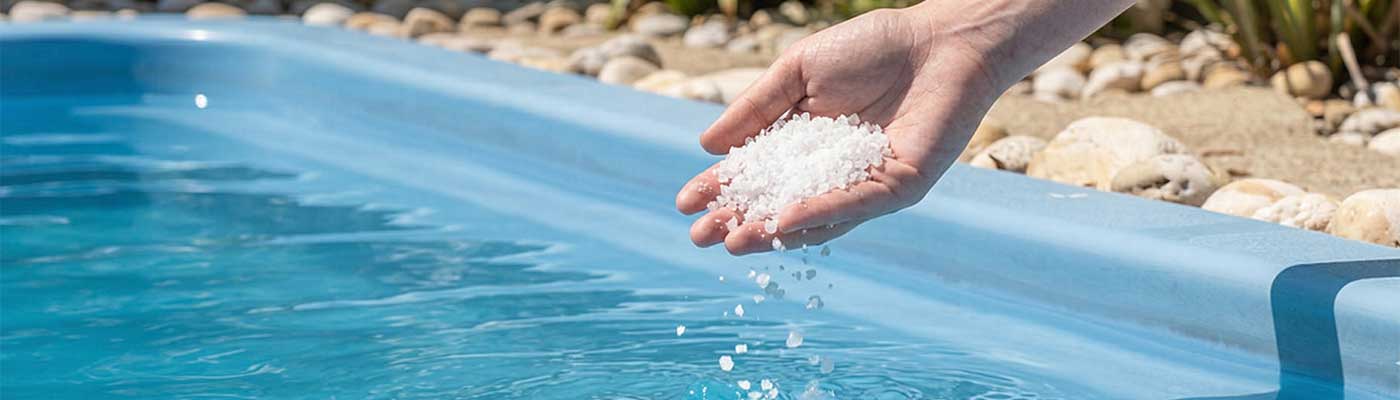
The golden rule for a healthy salt concentration in your pool has these days shifted to a slightly higher buffer for optimal disinfection. Where 3 or 3.25 kg was often advised in the past, at Salt Giant we use a standard of 4 kg of salt per 1,000 litres of water.
This dosage ensures your salt electrolysis system can produce chloride efficiently, even on warm days when bacteria grow faster. Do you have a pool of, say, 20,000 litres? Then for the initial start-up you need 20 x 4 kg = 80 kg of pool salt. That's 3 to 4 bags of 25 kg.
Why is the right pool salt dosage so important?
Finding the 'sweet spot' in your salt level is crucial for the lifespan of your pool. A saltwater system works via electrolysis: it converts salt into natural chlorine.
With too low a salt level: The system often gives an error message ('Low Salt'). Production of disinfectant stops, giving algae and bacteria free rein. Your water turns green or cloudy in no time.
With too high a salt level: Although you don't taste it directly (seawater is a factor of 10 saltier), an excess can cause corrosion. Aluminium steps, heat pumps and the seals of your pool pump can be affected. So always stick to the 4 kg standard, unless your system's manual explicitly specifies a lower value.
Step plan: how to add pool salt safely to your pool or spa
Adding salt is more than simply emptying a bag into the water. For the best result, follow this professional step plan:
Calculate the shortfall: First measure your current salt level (with a new fill this is 0). Use the 4 kg per 1,000 litres guideline to determine the required number of kilos.
Distribute the salt: Cut open the bags and spread the salt evenly across the deep side of the pool. Preferably do this in the evening, so the salt has all night to dissolve.
Turn the pump on, but the electrolysis off: This is the most common mistake. The pool pump must run for 12 to 24 hours to mix the salt. However, the saltwater system itself must stay off until all the grains have fully dissolved, to prevent damage to the electrolysis cell.
Brush the bottom: Still see salt grains lying around? Use a pool brush to speed up the process and prevent stains on the liner.
Test the values: After 24 hours, check that the salt level is around 4,000 ppm and that the pH value is between 7.2 and 7.6.
Which type of salt should I buy for my salt electrolysis?
Not every salt is suitable for your pool. Many people make the mistake of using cheap table salt or industrial salt. However, this often contains iodine or anti-caking agents that negatively affect your water quality and can cause brown stains on your liner.
At Salt Giant we supply exclusively high-quality, vacuum salt with very high purity. This salt is free from additives and dissolves rapidly without leaving residue. This is not only better for your water, but also extends the lifespan of your expensive electrolysis cell.

Pool salt price
Pool salt as a disinfectant is really a smart choice, and good for the environment too! You can use the same salt throughout the entire swimming season. You only need to top up if you've lost a lot of water and refill the pool. The amount of salt you need depends on the size of your pool.
Do you have a small pool? Then two bags of pool salt are often enough. For an average-sized pool you can count on around £100 per year. Nicely affordable, right? So you can enjoy that refreshing dip without worrying about the cost!
Questions about pool salt? We're here to help!
After reading this article, do you still have questions about the amount of pool salt needed? No problem, we're ready to help you further! You can reach us from 9:00 to 17:00 on 01902214281. Don't hesitate to contact us, we're happy to help.
Frequently asked questions
How often do I need to top up pool salt?
In principle, salt doesn't evaporate. So you only need to top it up if you lose water through backwashing (rinsing the filter), heavy rainfall that dilutes the water, or a lot of splashing. On average you check this once a month.
My hot tub shows a salt warning, what now?
A hot tub has a much smaller capacity (often between 800 and 1,500 litres). Here precision is even more important. Calculate exactly how many grams to add. Usually one or two kilos per season is enough.
Is salt water better for my health than chlorine water?
Absolutely. The chlorine produced by salt electrolysis is much purer. Users experience red eyes less quickly, less dry skin, and no strong "chlorine smell" on the body after swimming.
What is the ideal pH value in combination with salt?
The pH value is the engine of your disinfection. Salt works best at a pH between 7.2 and 7.6. Is your pH too high? Then your expensive salt system works half as well. So measure this weekly!