Free shipping above £ 25
 2 working day delivery
 Pay in 3 installments







What is food salt?
Do you know food salt? It's also known as table salt. It's not only a flavour-maker in our food, but also replenishes our minerals. And did you know it's even used in the cosmetics industry? In this article you'll discover all the types of food salt, the difference between sea salt and table salt, and the effects on our health. We'll also tell you what to look out for with table salt and whether you can use it as gritting salt. Curious? Read on!
Types of food salt
There are a few different types of salt that people use to spice up their food. Think of vacuum salt, rock salt and sea salt. These are really the big shots when it comes to salt. So let's take a look at what you need to know about these salt varieties.
Vacuum salt
Vacuum salt is actually our ordinary table salt that we're all familiar with. It comes directly from salt mines. So what happens is they inject water into these underground salt layers and a kind of brine forms. They bring that brine up, purify it and let it evaporate into salt. Pretty cool, right? For bakeries and home use they add some iodine, and in the meat industry they add nitrite to the salt.
Rock salt
Rock salt also comes from underground mines, but here it's extracted differently. Instead of purifying it from brine, it's scraped directly off the rocks. It's then purified and prepared for sale. Rock salt is also known as halite, and it's actually just sodium chloride, just like the salt you use in the kitchen.
Sea salt
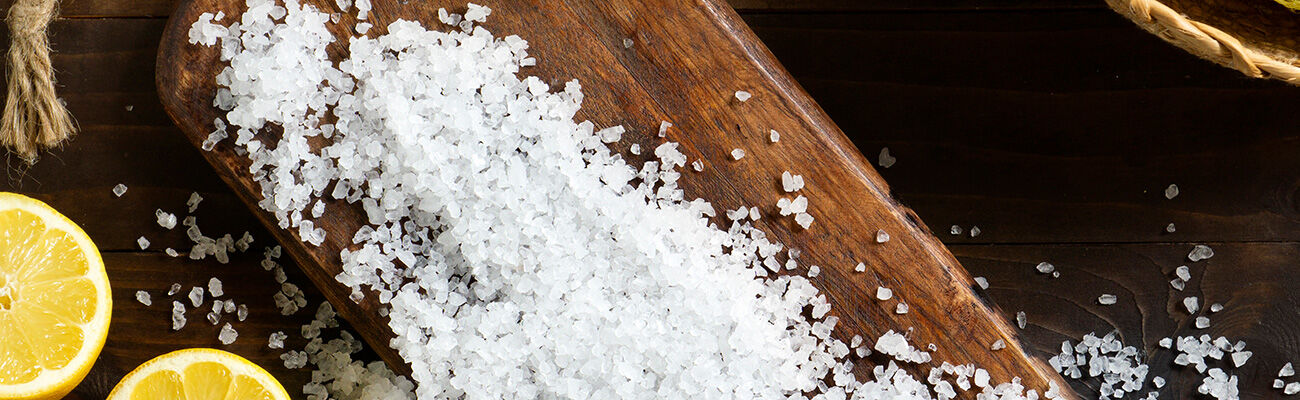
Sea salt simply comes from the sea, straightforward. What happens is that seawater is collected in basins or salt pans and left to evaporate there. The salt is then skimmed off and dried further. The interesting thing about sea salt is that it has a subtle flavour and is packed with minerals, such as sodium chloride, magnesium chloride and calcium chloride. Because of these minerals, sea salt is not only good for seasoning your food, but also handy for your skincare. You can use it, for example, as a body scrub, against dandruff or for making face masks.
Difference between table salt and sea salt
Table salt can be a mix of different types of salt, such as sea salt and vacuum salt. Iodine is often added because we generally eat too little fish, while fish is normally a source of iodine. Not all types of sea salt naturally contain iodine, so if they do, this is usually stated on the label.
Which salt is healthy?
When we talk about the health effects of salt, it's really about the health effects of sodium. Sodium plays an important role in maintaining the fluid balance in our body, regulating blood pressure and the proper functioning of muscle and nerve cells. But beware, it's crucial not to consume too much salt. Too much salt can lead to high blood pressure, which increases the risk of cardiovascular disease.
Natural foods don't contain much salt naturally. About 80% of the salt in our diet is added by manufacturers to improve flavour, shelf life and texture. We add the remaining 20% ourselves during cooking or at the table.
When do you have too little salt in your body?
As mentioned earlier, salt in food is essential for a good fluid balance, healthy blood pressure and the proper functioning of muscles and nerve cells. When you have a salt deficiency, this can affect your health. Such a deficiency can arise, for example, from dehydration, such as with a severe stomach bug.
If you become dehydrated, unpleasant symptoms can occur such as drowsiness, confusion, nausea and headache. In such a case, it's extremely important to restore your fluid balance as quickly as possible.
When have you eaten too much salt?
A salt surplus is more common than a deficiency. Around 80% of people consume too much salt. The recommended maximum is six grams of salt per person per day, but on average we consume around two grams more than that.
If you consume too much salt, your body retains more fluid. This puts pressure on your blood vessels and forces your heart to work harder, which can lead to high blood pressure. In addition, a surplus of salt increases the risk of cardiovascular disease, kidney disease and even stomach cancer.
The impact of salt on industries
Table salt finds its way into various industries, such as the bread and cheese industry, the fish industry and the meat industry. In the meat industry, for example, nitrite salt helps inhibit bacterial growth and prevents meat from developing an unpleasant brown or grey colour. It also improves the texture and gives meat a tasty flavour. Not to mention that nitrite salt also extends the shelf life of meat.
But let's not forget the baking industry, where perhaps the most table salt is used. Salt makes the dough easier to work with and gives the bread a delicious flavour.
Difference between gritting salt and food salt
Many people wonder whether table salt is also suitable as gritting salt. In principle, gritting salt is just table salt, but it's slightly less pure because an anti-caking agent is added. Small amounts of table salt can be used for gritting, but it doesn't work the other way around. Do note that the anti-caking agent can cause irritation and even burns with prolonged skin contact, so be careful.
What to look out for with food salt
It's super important that food salt meets the relevant food safety guidelines. Otherwise it can't even be sold, because it might be bad for your health.
These rules state, for example, that food salt must be free from gluten, dioxins, pathogens, allergens and micro-organisms. And check this, it also must not be irradiated, smoked or genetically modified. When table salt meets all these important requirements, it gets that well-known quality mark. And that's what you want to see when you buy it!
Questions about food salt? We're here to help!
After reading this article, do you still have questions about using table salt? No problem, we're ready to help you further! You can reach us from 9:00 to 17:00 on 01902214281. Prefer to send a message? No problem, we're also available via WhatsApp!